What? Black and Gray Only, No Colors??!!

November 12th, 2009

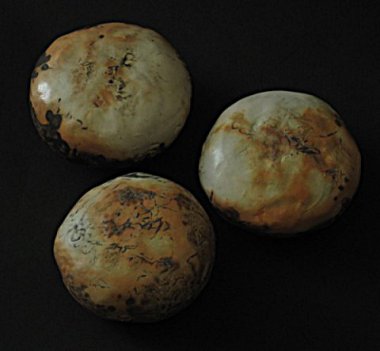
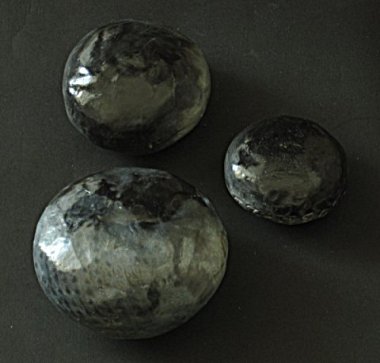
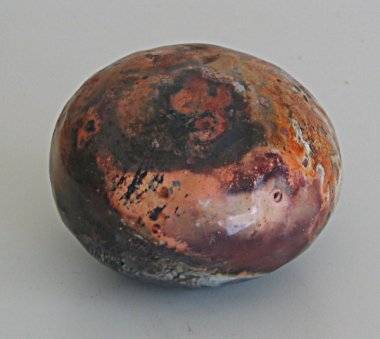
I thought it was just a fluke the first time this happened. I was at a group pit fire last year where I had seven pieces out of a total of thirty some pots in all. Most of my pieces turned out beautifully, so I wasn’t too upset when I noticed that one of them did not have any colors at all — only black and various shades of gray.

three recent black-and-gray pieces

figure 1: three recent black-and-gray pieces

Well, it must have been in a corner where we forgot to sprinkle copper carbonate; and the copper mesh and salted raffia wrapped around the piece must have gotten knocked loose by falling logs too — so I thought to myself, and promptly forgot about the whole thing.

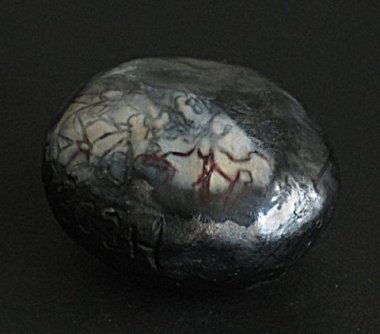
Then I started to do a lot of firings in my little backyard pit, and much to my chagrin, these all-black or black-and-gray rocks also began to crop up a lot more frequently (figure 1 above, and figure 2 below.)

Read the rest of this entry »

Free from Copper Carbonate, Finally…

October 25th, 2009

Those of you who have followed this blog for a while would know that I’ve long been looking for proofs that one doesn’t need copper carbonate, a toxic (and expensive) chemical, to achieve the kind of maroon reds and blueish grays commonly associated with copper fuming.

I came really close to showing that I can get the same effects with copper netting from “Chore Boy” type copper scrubbers; but a real proof would require not having any copper carbonate in the pit at all — which I couldn’t really do in a group firing, where other people were there to get nice results for their pots, and not to help me prove or disprove some fine point in pit firing theories.

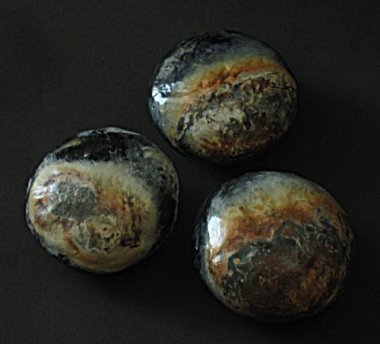
these are fumed with copper-coated scrubber

figure 1: these are fumed with copper-coated scrubber

But now I have my own test pit, and the only pots at risk are my own. Woo-hoo! So after two successful firings using my standard method, proving that this test pit works just as well as any other I’ve used before, I went for a test firing with no copper carb at all in the pit, and was very pleasantly surprised to see some very respectable looking results (figure 1) for my efforts.

Read the rest of this entry »
The Perfect Test Pit

October 18th, 2009

Three years ago, when I first started this blog, I wrote about using a BBQ smoker for pit firing, because I did not want to draw unwanted attention from nosy neighbors and fire marshals. As those of you who live in modern big cities would know, we often have all kinds of fire ordinances and burn bans to contend with, and striving for a look of innocently doing what every other urbanite or suburbanite would be doing is an important ruse for self preservation, if one is to succeed in pit firing in the city (or suburb) in the long run.

Unfortunately these BBQs didn’t work out all that well, as they were not designed for the prolonged high heat generated by a log burning fire. My BBQ smoker, for example, has paint on it that would start to burn after a while, and would give out noxious fumes and visible black smoke. Talking about trying not to draw attention! So I gave up this approach after just a few times.

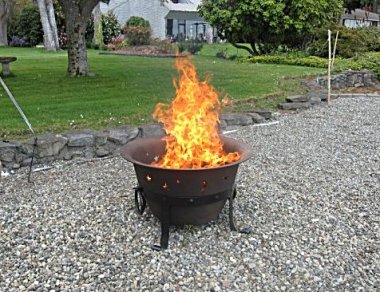
cast iron fire pit

figure 1: the cast iron ‘fire pit’ in action

Then I started to see these stand-alone outdoor ‘fire pits’ made of metal or clay at the patio furnishings section of department stores. Would these work for my purposes? After all, they were designed to burn logs, no? So I bought a cast-iron one (figure 1) from Home Depot and start to experiment with it. I did my first firing with it at the end of April this year.

Read the rest of this entry »
Fuming Materials: A Mini How-To

December 11th, 2008

Well, well… it’s been over a year since my last post here. Though I did not get to fire much in the last two years, I finally managed to achieve fairly consistent results by the last couple firings. The firing method remains essentially unchanged, i.e. a fast 6-hour affair in a relatively shallow pit, details for which can be found here and here. And I still use mostly cone 6 porcelaneous clay, but now bisqued to cone 010 instead cone 06.

(Update 2009-10-25: now I typically bisque my pieces to cone 012 instead.)

recent pit fire result

figure 1: a recent pit fired piece

What I want to write about in this post, though, is how I use fuming materials to achieve the kind of results as shown in photos above (figure 1) and below (figure 2). This approach, of course, does not work aesthetically in all situations — so I am offering this only as a hopefully useful reference. As always, take whatever you need from it and adjust to your own requirements as you see fit.

Read the rest of this entry »

A Tour of My Studio!

July 12th, 2007

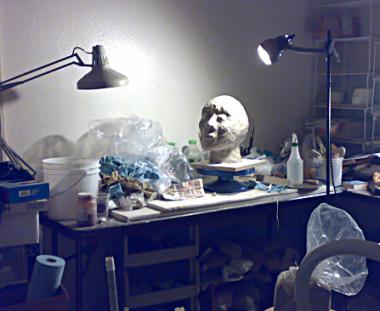
Finally got my own clay studio set up at home. My former living room has turned into the sculpture and handbuilding area (figure 1). There used to be a couch here, but now it’s just two work tables and a few shelving units. Sometimes, late at night, these half finished clay heads would feel as if they were alive…

studio-1.jpg

figure 1: sculpture studio is my former living room

Read the rest of this entry »

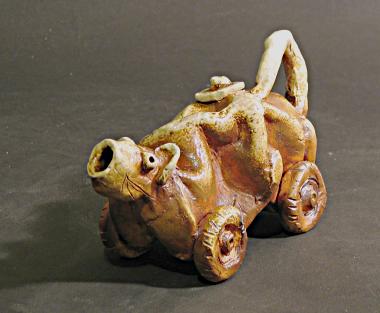
Teapot-Rats Back from Soda Kiln

July 9th, 2007

You’ve seen them before in greenware form, but now they are back from the soda firing — the same firing where you saw me sparying soda into the kiln. Here is one of them, below:

img_0229xb.jpg

mutant teapot rat #1

Read the rest of this entry »

More Funny Ware

October 5th, 2006

These are proud happy guys driving their hard earned Mercedes. Funerary ware, reduction fired to cone 6 in a gas kiln. One is about 3 inches tall, the other 3 and 1/2. Perfect memento to remind yourself of your achievements in this world as you journey into the next one…

img_0140a.jpg

La Condition Humane

October 5th, 2006

Okay, I’m too busy to post something more useful or meaningful for the moment, so here are just a handful of funny figurines grouped together under a fancy title (in French, no less) for your amusement. :-) They were all made by pinching, stand between 2 to 4 inches tall; some were saggar fired, others are just plain bisque ware.

img_0133a.jpg

Pit Fired Hot Dogs

September 22nd, 2006

This is a clip about lunch for the Pottery School pit fire at the beach. We forgot to bring BBQ equipment but hey you can do a lot with Raku tongs, Raku gloves, a shovel, a length of heavy gauge copper wire, and a healthy dose of ingenuity… Kudos to Mike, Liz, Aimee, et al. for being so inventive.

Pottery School Pit Fire at the Beach

September 22nd, 2006

This is a video clip of a group from The Pottery School in Pioneer Square doing a pit fire at the beach in late July.

The firing was pretty similar to the Vashon Island firing except most pieces had no terra sig on them. They were all bisqued to cone 06. Here is what I have written down in my notebook about the pit layout:

  • pine sawdust: ~3 inches
  • horse dung: ~ 1/4 to 1/2 inches
  • copper carb: ~ 1/2 coverage of pit bed
  • baking soda: sprinkled around (but not on top of) some pots (not a lot)

The pots were mostly in a single layer (only 2 small pots were on top of other pots.) Copper carb was used more sparingly than the Vashon firing, and there was none on top of the pots. Besides the usual salted raffia, Chore-Boy copper netting, and steelwool strands that I brought, the participants also used copper wire of different sizes, inclulding some heavy gauge ones, as a fuming material.
Read the rest of this entry »